
Server security
Record Vulnerabilities, a Global Email Outage, and the Two Things Every Business Should Do Now
By Avery Parker, Diversified Tech Solutions ·
I've been in IT long enough to see plenty of "busy years" for security. This one is different.
If you work in IT security, or you maintain public web servers, you already know we've been under constant attack for a long time. On the servers we manage, I see thousands of automated attempts a day. That isn't new. What's new is how fast problems are being found, and how quickly they can be turned into attacks.
I wanted to put real numbers behind what we've been seeing all year, so we pulled the data straight from the National Vulnerability Database (NVD) and CISA's Known Exploited Vulnerabilities (KEV) catalog on November 18.
The numbers
From January 1 through November 18, 2026, there were 102,726 CVEs published. A CVE is a publicly listed security flaw in some piece of software or hardware.
All of 2025 had 49,972. We've already more than doubled last year, up 106%, with six weeks still to go. Over the same January to mid November window last year, the count was 43,393.
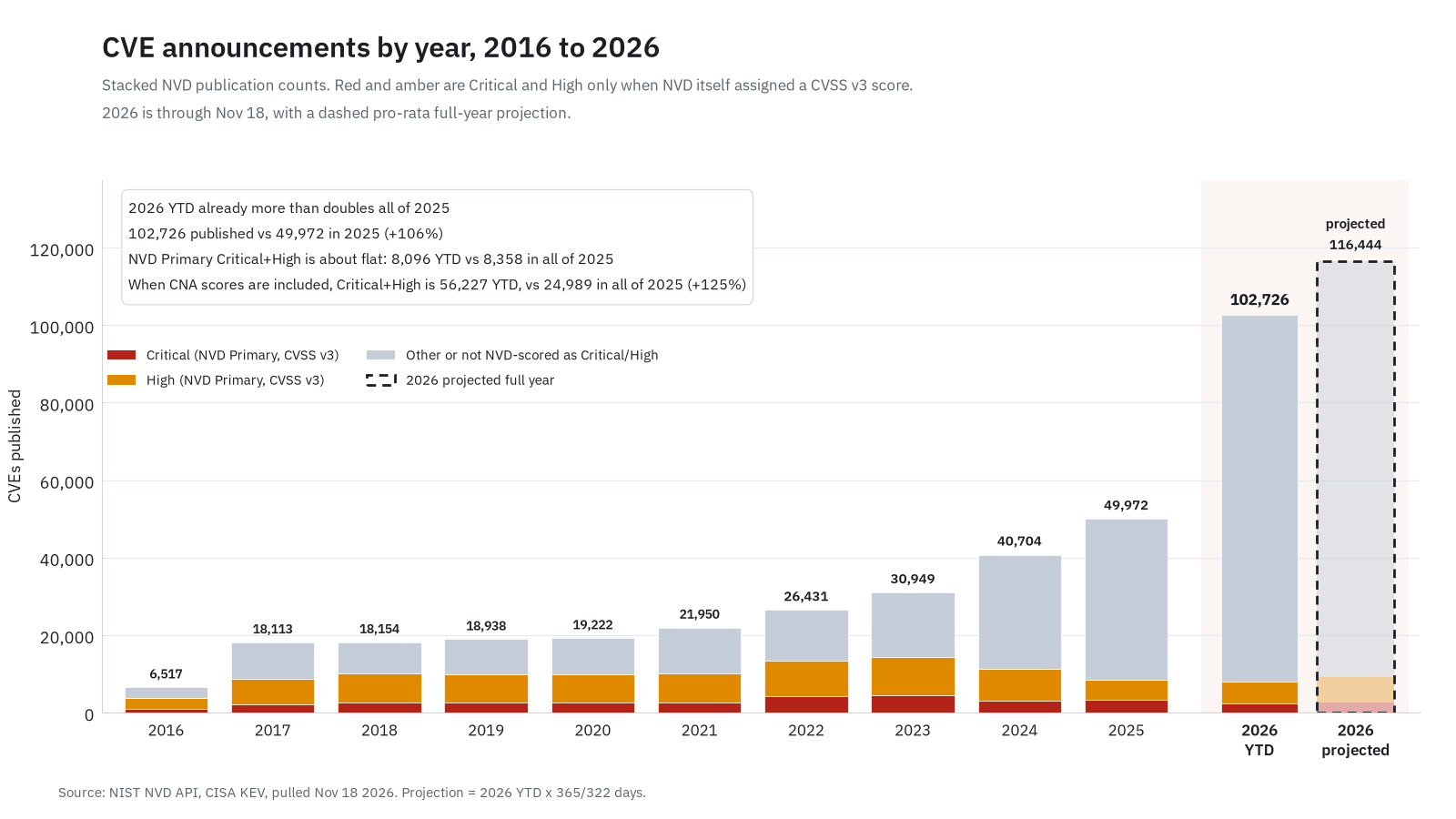
If you extend this year's pace across the remaining days, 2026 lands around 116,000 CVEs. That's a straight-line estimate, not a forecast, and it could come in higher.
Monthly counts started around 5,100 in January and climbed almost every month after that. October was the peak at 17,481, right in the middle of Cybersecurity Awareness Month, and November is still running heavy.
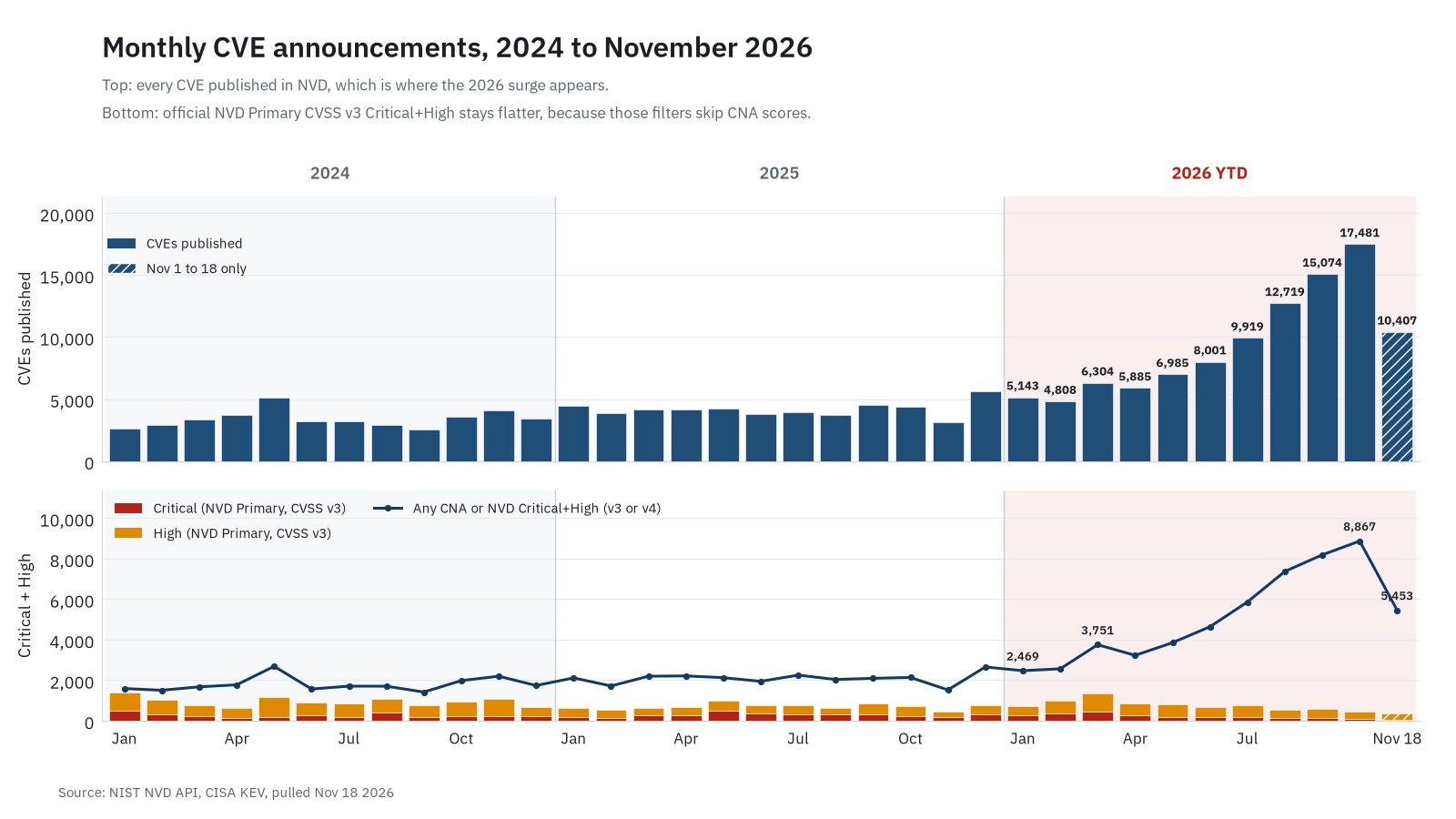
Counting the best severity score from any source, either the vendor or researcher who filed the CVE or NVD itself, 56,227 of this year's CVEs are rated Critical or High, up 125% from 24,989 in all of 2025. (NVD's own scoring makes Critical and High look flat, around 8,096, but only because NVD hasn't scored most of the new records yet.)
The number I watch most closely is CISA's Known Exploited Vulnerabilities list, the flaws attackers are actually using. CISA has added 298 so far this year, compared to 245 in all of 2025. That's still below the 2022 peak of 555, but it's heading the wrong way.
Why this is happening now
I believe the widespread availability of AI tools is a big part of it. AI makes it faster to find flaws in software, and easier to turn those flaws into working attacks. The automated tools hitting web servers are getting faster and more sophisticated.
Some of what we've seen in the last week could well be the work of state-sponsored actors. But the threshold is now so low that it doesn't have to be. The same way one person can run a company with AI agents, one person can run a campaign against certain services.
Headlines about "autonomous AI agents" are mostly overblown, as if nobody had directed them. I run autonomous agents myself. They check my mailbox, give me updates, and summarize reports. That's useful, and it's still me giving the direction.
Stories about a "rogue" AI agent breaking out of its sandbox and hacking a site are overdramatic too. Somebody gave those systems directions, and they tried to do what they were told. They may have ignored guardrails and safeties, and a network that was supposed to be isolated probably wasn't as isolated as people thought.
Ask a person to do whatever it takes to get you a hundred dollars this afternoon. Most would start at an ATM, then maybe try to sell something. If they felt bound to follow the instruction, were they acting on their own, or following a direction? The person who gives the job is still responsible for it.
To be clear, this is not a call to regulate AI. The same tools that help attackers find weaknesses can help us find them first, patch faster, and spot attacks sooner. Defenders need to be using AI too.
When we get through this season, I think we'll have a more secure baseline for software than we've ever had. It's just going to be a hard process getting there.
So what does that mean for a small or mid-size business? I'd boil it down to two things.
1. Keep your internet-facing services properly maintained
Your website, your mail server, your remote access, your firewall. These are the front doors attackers check first, and they check them all day.
"Properly maintained" means a few specific things:
- Patched on a schedule, and fast when it counts. Updates for your website platform, plugins, server software and firewall shouldn't wait. Anything on CISA's KEV list deserves attention within days.
- Inventoried. Know every system people can reach from outside, including that old test site or forgotten remote access tool. You can't patch what you don't know you have.
- Locked down. Multifactor authentication (MFA) on email, admin logins, and remote access. Old accounts removed.
- Monitored. Someone should be watching login failures, uptime, and unusual activity, and acting on it.
- Backed up and tested. Keep at least one copy separate from your network, and actually test a restore.
None of this is flashy. It's the routine work that keeps a business off the list of easy targets.
2. Plan for the day something you depend on goes down
Security isn't only about attackers. Sometimes the problem is a service you rely on failing.
On November 12, a Microsoft 365 outage left users around the world unable to reach their email for close to 24 hours. Outlook, Exchange Online, Teams and Copilot were disrupted, and mail delivery was badly delayed. Microsoft's preliminary report traced it to a software bug introduced months earlier, combined with a traffic surge and reduced server capacity. (BleepingComputer, Nov 16, 2026)
That wasn't a small business making a mistake. It was one of the biggest providers in the world. If your whole company runs through one email system, one phone system, or one internet connection, you need a plan for when it isn't there.
A continuity plan doesn't have to be a binder nobody reads. Start with a few questions:
How will you reach your customers?
- A simple status page or website banner you can update from anywhere.
- Text message (SMS) alerts for key customers or appointments.
- Your social media profiles and Google Business Profile, so customers know where to look for updates.
- A secondary email route, such as a backup domain or provider, so critical messages still get out.
How will your team talk to each other?
- A phone tree or group text that doesn't depend on your main email or chat platform, with key cell numbers written down somewhere you can reach offline.
How will you keep working?
- A backup internet connection, like a cellular hotspot or a second provider.
- Offline copies of the things you can't work without: customer contacts, schedules, open orders, key procedures.
- A clear decision on who says "we're switching to the backup plan" and when.
Write it down, share it with your team, and walk through it once. The middle of an outage is a bad time to figure out who has the password to the website.
Where to start this week
If this feels like a lot, start here:
- Check that your website and mail server are fully patched.
- Turn on MFA anywhere it isn't already on.
- Confirm your backups restore.
- Make sure you can update your Google Business Profile and social pages from a phone.
- Write down how you'd reach customers if email went down tomorrow.
- Ask your IT provider how they're using AI to help defend you.
Let's talk
This is the work we do every day at Diversified Tech Solutions: keeping websites, mail servers and networks maintained and monitored, and helping you plan how you'll reach customers and keep working if a service you depend on goes down. If you'd like to talk through where your business stands, reach out on our contact page: https://diversifiedtechsolutions.com/contact/.
Sources: NIST National Vulnerability Database (NVD) CVE API and CISA Known Exploited Vulnerabilities catalog, both pulled November 18, 2026. Microsoft 365 outage details from BleepingComputer's Nov 16, 2026 report on Microsoft's preliminary post-incident review. The thousands of daily automated attempts are from our own experience managing public web servers.